Search This Blog

Showing posts with label Dairy/Cheese Making. Show all posts

Sunday, September 30, 2018

End of an Era

It is with wildly mixed emotions that I am posting here to announce the imminent closing of the Dairy at Black Mesa Ranch.

After an amazing 15-year run making and selling artisan goat cheeses to some of the best restaurants and resorts in the state, through Whole Foods, and retail from our website, we have decided to move on to the next thing.

Getting out at the top of our game is bittersweet. Our cheese business is going great and we sell everything we can make. Kathryn's goat herd is stunning and consistently scores in the top spots in the country, with national awards and recognitions for production and confirmation.
 
On the other hand, a dairy is a 24-7-365 business. It's exhausting and while ultimately rewarding, it can also be overwhelming for just two people. Our lives revolve around twice-daily milking and while we usually do it together, it can be done by just one of us (not fun).  We haven't had a vacation together in 15 years so, for the sake of our sanities, we need to downsize and reevaluate for the future.

The exciting news? This will allow us to concentrate more fully on our confection business, plus take on a new challenge... We are opening a new food truck and catering business! (More on this in future posts).

We expect to finish cheese-making soon and then disburse the goat herd. Guestimated final closing in early 2019 when we will sell the dairy equipment, etc.

Sunday, July 10, 2016

Obsessing about Cheese Cloth (The Good Stuff)

We had a great visit earlier this week with Niki D'Andrea, the Managing Editor for PHOENIX magazine, and her folks.  She came to the Ranch to interview us and take some pictures for an article coming out this fall.  After the Grand Tour (goats, cows,  pigs,  sheep, solar & wind power sources, garden, greenhouse, doe barn, buck barn, milking parlor) we ended up in the cheese kitchen.  There we did some cheese, fudge and Spiced Pecan sampling and I talked about cheese making.  We were discussing how we make fresh cheese and were looking at the beautiful cheesecloth bags full of fresh curds from this morning when Niki innocently asked “What kind of cheese cloth do you use?” So, I told her...

The cheesecloth we use for hanging our fresh curds, draining our feta and for lining the molds of our pressed aged cheeses is a special type of cheesecloth.  It’s not at all like that coarse, open-textured stuff they sell in the hardware store as “cheesecloth”  Our cheesecloth is 100% cotton.  It’s a very fine weave called a 90 count.  The correct technical name for it is “butter muslin” and good butter muslin can be very hard to find.


We had been getting our butter muslin from the same source for about 8 years when we started noticing a change in it.  The nice neat weave started seeming more crooked and uneven.  There was a lot more “frass” (bits of loose thread etc) in the cloth and we were seeing more and more pills/knots/stitch drops/slub/barriness (various woven-cloth manufacturing defects). The cloth was also more frail and fragile, only taking a few washes before it was completely shot.  If you’re REALLY interested in the subject of fabric defects here’s a pretty good slide show on the subject: http://www.slideshare.net/sheshir/knitted-fabric-faults-and-their-remedies.

We contacted the owner of the company where we were getting the cloth and spoke to her at length on the phone.  I think she thought we were a bit loony-toons or maybe just OCD about it.  She was nice enough but didn’t really grasp how different it was.  She didn’t know how she could help but said she’d look into it.

We started thinking maybe we were wrong.  I mean, cheese cloth is just cheese cloth, right?  Fortunately, just about this time, we found a small remnant of the old, high quality cloth and compared it side-by-side with some from a new box we’d just opened.  Night and day!  We were not crazy (or at least not about the cheese cloth!).  We packaged up the two samples and sent them off to our supplier.

A week or so later the owner called us.  She said she had looked at the two samples and could not believe the difference.  She now understood exactly what we were concerned about and that she was in the process of tracking down the manufacturer (somewhere in the mid-west) to try and find and answer.

More time passed and we suffered along with the inferior cloth until one day she called again.

“I have some news for you. I spoke with the owner of the cloth manufacturing plant and he told me that earlier in the year he had begun out-sourcing production of his butter muslin overseas.  He was aware of the quality differences but didn’t think anyone else would notice or care.”

We reemphasized that WE CARED and was there any chance he had any of the good-old-made-in-the-USA stuff available?  Puh-leeeeese?

She said she would ask him.

A few days later she called back again.  She’d had a long conversation with the plant owner, who had gotten in touch with one of his foremen, who had checked with his guys on the factory floor.  The word was that  yes, “somewhere around” there was indeed some of the USA-made cloth still at the shop.  It hadn’t been bleached and finished or boxed but they would be willing to do that for us if we would buy a full master case of it.

A master case is a LOT of butter muslin.  We figured it would probably last us 10 years, maybe longer.  And it wasn’t cheap!

Oh what the Hell. You only live once and life is too short to use crappy cheese cloth!  We told them to go for it!  Imagine that... BMR was having it’s cheese cloth custom made!

We had to pre-pay, of course, and it took maybe a month before our intrepid UPS driver Joe staggered up the front deck steps with a huge box.  It was finally here!!!

With great joy we tore open the master case and broke out one of the boxes.  We opened the box and....

Our jaws hit the floor. NO! It can’t be!  It was the same CRAP we’d been having to use for months!  WE’D BEEN ROBBED!

Of course we called our cheese cloth supplier immediately and told her.  She couldn’t believe it either.  “Impossible.  I saw to that order myself.  As soon as your cloth came in I had it sequestered in my office and...”  Her voice trailed off.   “Oh.”  “Oh my.” “Ummmm... I seem to have your case of cheese cloth still sitting here in my office.”

She apologized profusely and said she would get it out to us on the next shipment, which she must have done, as a couple of days later another huge box arrived.  This time it was the good stuff.  We actually started calling it that.  We still had some of that foreign-made junk around but made sure to use it for cleaning the tractor or something.  Cheesemaking ALWAYS gets The Good Stuff.


This all happened about 5 years ago and we’re still going strong with The Good Stuff.  I don’t think we’ve even gone through half of it and we still treat it like royalty so I’d say we have at least another 5 years of supply left.  Still, even the thought of having to find good cheesecloth again in 5 years is more than a little daunting.  Maybe we’ll just have to retire when we run out of The Good Stuff.

I’m not sure if Niki and her family were impressed with the story or overwhelmed but they were kind enough to tell us “That was very interesting”.  On the other hand, they did leave rather quickly after that!

Tuesday, January 25, 2011

Personal Cheese Update - 4 more cheeses


Four more of the "personal cheeses"  that I made starting back  in December are ready for testing!.  A Gouda, a Havarti, A Monterey Jack and a Pepper Jack.
Not being one who is overly patient in such things, I slated all four for today's lunch and put together a simple cheese plate meal with some fresh bread.
All of these cheeses were made from our own goats' milk, of course, which makes them each come out a little differently from the same cheeses when made with cows' milk.  That said, they were all very good and quite different from each other, if not perfect representations of their types.
Monterey Jack
Actually, the Jack and Pepper Jack cheeses were both exactly what I had been aiming to make.  The Gouda was sweet, fresh and tasty but the texture was a little too open and it seemed a little immature.  This, it turns out, was my fault as I had misread it's "due date" and had opened it several weeks early.  D'oh! The Havarti was excellent but was, for some reason, missing the many tiny gas holes in the pate that is typical for the cheese.
We are looking forward to enjoying theses cheeses a lot in the near future both on their own and to cook with.

Sunday, January 23, 2011

Cream from Milk - Mechanical Separation


Today I need to separate the cream out of about 10 gallons of goats milk in anticipation of churning some goat butter tomorrow.
Goats milk is quite different in composition and construction than cow’s milk.  Take the cream, for example.  With unprocessed (specifically, not homogenized) cow’s milk, the cream will readily rise to the surface if left alone for a few hours or overnight.  Not so with goats milk.
Goats milk is said to be "naturally homogenized" because the butter fat molecules in goats milk are so much smaller  by comparison to those in cow’s milk, that they more easily stay suspended in the liquid. (This coincidentally , is one of the reasons that goats milk is considered to be much easier to digest than cow’s milk).
In order to get the cream out of goats milk - either to obtain the cream for other use or to make a lower fat milk product - it must be mechanically separated.  Typically, the way this is done is with an apparatus called a "cream separator" (imagine that!).
Cream separators come in many sizes/capacities and can be successfully made from a number of different materials but nearly all work on the same operating principle: centrifugal force*.  Even though the butter fat molecules are small and in suspension they are still lighter than water (the primary component of milk) and so the act of accelerated spinning works to separate the fat from the milk. From that point all that is left to do is send the butterfat-rich milk (cream) in one direction and the butterfat-poor milk (skim milk) another.
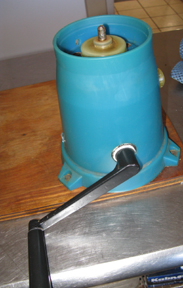
Cream separators have lots of parts that have to go together in just the correct order for it to work properly.  Mine, an old Russian-made, hand crank model with predominantly plastic parts, has over 20 milk-contact parts, plus the crank/transmission unit. 
Here are several pictures of the parts, the sub-assemblies, and final assembly...


To get the best results from a cream separator the most important thing (aside from the correct assembly of all the parts) is to have the milk at the proper temperature.  I have found that 101-103 degrees F (which happens to be a normal goat's body temperature) works best for goats milk.  Too hot and it seems not to get all the cream out of the milk.  Too cool and it gums up the separator plates, clogging up the works.  My unit has a set-screw adjustment that is supposed to let you make heavy, medium, or light cream but it does not seem to have any effect when I have tried it.
The actual separating is easy.  Once the milk is to temperature it is poured into the hopper.  The crank is turned at about 60 rpm (one revolution per second). The flag valve is opened and a stream of milk flows to the bottom of the assembly of plates which, because of the gearing, are now spinning quite fast.  The milk flows through the plates which have a series of holes that direct the heavier elements one way and the lighter another.  The two streams of separated milk find their way to the 2 spouts with a pretty good flow of skim milk going one way and a smaller drizzle of cream the other.


My hopper takes about a gallon of milk so it had to be refilled several times. DO NOT stop turning the crank when there is milk flowing through the machine or it will make a huge mess by flowing out everywhere except from where it is supposed to!
I normally expect to get about a quart of cream from 4 gallons of milk but I had never separated cream at this time of year.  We know from both the milk quality testing we do and the cheese yields we get, that our milk gets much richer in the fall and winter than it is in the summer. We have individual goats who we know can produce milk with about 10% butterfat late in the year (by comparison, regular whole milk at the store is about 3.5% butterfat), but I was still surprised by my yield. 
Today I got 6 quarts of very heavy cream from the 10 gallons of milk!
Tomorrow I will be churning all that cream into Goats Milk Butter.
*Strictly speaking there is no such thing as "centrifugal force". The force we commonly refer to as centrifugal is actually the inverse or absence of "centripetal force".  Confused? Look it up.  Here's a place to start... http://en.wikipedia.org/wiki/Centrifugal_force

Friday, January 21, 2011

Personal Cheese Update - 2011 Brie #1


The three Bries I made just before Christmas were scheduled to be ready to try today and since Kathryn just returned this morning from a week-long trip across the country visiting family and friends, I thought it would make a nice lunch with some fresh bread.

All three cheeses have been ripening in a 50 degree F aging box, wrapped in parchment paper, then aluminum foil, getting turned and flipped about twice a week for the last few weeks They felt like they were all softening so I pulled one out to come to room temperature about an hour before lunch, loosening the wrappings so it could breathe a little.


As I started to cut into the cheese the skin broken slightly and some lovely, white proteolyzed* cheese goo leaked out.  I was surprised upon continuing the cut that the proteolysis had not penetrated further and more evenly.  While definitely ripening throughout, the softest pate was segregated to the outside layer, just under the white mold (penicillium Candidum) skin.  Just to be clear, and as gross as it may sound, proteolysis is a good thing!  We like our Brie soft and gooey and "protein degradation" is how that happens.

Regardless, we each took a wedge and some sliced bolillo bread. The cheese was very good with a rich mushroomy flavor all the way through and while still a little too firm in parts, completely spreadable.

A good experiment.  I think I'll keep the two unopened Bries in their 50 degree F environment for another week while I research possible causes for the uneven ripening. The cut cheese will go to the regular fridge, re-wrapped in parchment and foil.

*Proteolysis is the directed degradation (digestion) of proteins by cellular enzymes called proteases or by intramolecular digestion. In this case the molds acting on the proteins in the cheeses.


1/22/2011: Took some of the Brie, spread it on thick slices of homemade bread, topped it with some sundried tomatoes and slivers o fresh garlic and toasted it in a hot oven for about 10 minutes.  Result... Fantastic!


Sunday, January 9, 2011

"Personal" Cheese Making


In our commercial dairy production of cheese here at the Ranch we make 3 types to sell: Fresh Goat Cheese, Feta Cheese, and Boule.  All three are considered "fresh cheeses" and must be made from pasteurized milk to be legal. (Click here for a previous post about raw vs pasteurized milk and cheese).
In our "off season", roughly from Christmas to the beginning of our hectic kidding season (this year in mid-February), we still keep a few of The Girls in milk and I still make cheese.  Most of these cheeses are destined for personal consumption (not for sale) during the rest of the year and I am free to make anything I feel like. Most of my personal cheese batches are small, starting with 5 gallons of milk (the cheddar starts with 10 gallons) and they yield between 5 and 8 lbs of finished cheese , depending on the type. This year we're getting lots of milk from the goats we're still milking so I have been able to make quite a few cheeses.
So far, since just before Christmas, I've made 21 personal cheeses: 4 blue cheeses, 3 Brie, a Monterey Jack, a Pepper Jack, 2 Gouda, 2 cheddar, 2 Feta, 2 Havarti, 2 Baby Swiss, and 2 Romano.  All of these I have made from raw (unpasteurized) milk.
I know this sound like an awful lot of cheese for 2 people to eat, but there is a method to the madness.  The beauty of this particular mix of cheeses is that they all mature at different rates and while some have a fairly limited shelf life, once ripe (for example the Brie which will be perfect for only a couple of weeks before starting to decline), many will continue to evolve and improve in complexity as they age.
The Feta will be ready to eat by the end of this week.  It is stored in brine and will keep well for at least 2 months with minimal attention.
The Jack cheeses will be the next cheese ready to try in about another two weeks, followed soon thereafter by the Havarti.  These cheeses are designed to be eaten while young and are not constructed for long-term aging so we'll be enjoying them in many different forms and guises for the next month or two.
The Brie will be approaching ripeness around the first of February and, as mentioned above, will only have a short 15-20-day period of perfection.  I can slow the ripening (or over-ripening) a little by moving them from their 50 degree F ripening environment to a colder fridge as they get close which so should help to stretch the three Brie out over at least a month.
The Baby Swiss and Goudas will all be close to ready around the first of March and while we may cut into one or more of them then, they will both improve with more age (and proper affinage, of course) so there is no time pressure on using them right away.
Two of the blues should be ready around the first of April and the other two near the end of that month.  I'm absolutely sure we'll be digging into one of these as soon as it is ready but, once again, with proper care, the rest of them will have many more months of shelf life.
Not surprisingly, the Romanos will be the last cheeses to be fully cured.  I like to age mine for a minimum of 6 months so the first one won't be ready until late June, but they are excellent when aged MUCH longer.  I haven't made Romano in several years and the wheel we are currently working on eating is over 4 years old!  It is very dry and must be grated for use but the flavor is complex and superb!
Yes it's still a lot of cheese for two people but, to be honest, we do share with family, friends and have even been known to provide some rather lavish cheese tasting meals for our workshop participants.  Amazingly, come next year at this time, I'll be hustling to make more "personal cheeses" with which to re-stock the cellar.