Search This Blog

Friday, November 5, 2010

Alternative Energy & Buildings Tour


This weekend is the annual local Alternative Energy & Buildings Tour and we've been asked back again, for the 5th year in a row, to cater the lunch for the group.

About the tour
For $25 you get to visit 5 or 6 homes and businesses in northeast AZ area that operate sustainably to one degree or another with various types of alternative building methods and off-grid energy solutions employed. This year I understand that there is a Geodesic Dome, a Yurt, a Log Home, a Straw Bale Home and a "Earthship" on the tour.  Various systems of solar power and or water pumping, wind power etc are in use in these buildings, some of which are attached to grid power and some of which are completely off-grid.  The tour is expected to take about 5 hours, plus a stop for lunch (included in the price).
About the lunch
This is not a fancy-feast event.  The folks at Val-U-Solar, who put the tour on every year have rented a meeting room at the Comfort Inn in Taylor AZ where we'll be setting up the buffet.  Here's the menu:
BBQ Chicken Lunch Buffet
BMR Fresh Goat Cheese Platter (Four varieties with crackers and toasts)
Tossed Green Salad
Salad Bar accompaniments and 2 dressings
Red Potato Salad
BBQ and Grilled chicken
Confetti Corn with roast sweet peppers
Cornbread with honey butter
Homemade cookie/brownie tray
Assorted hand-made chocolates (Goats Milk Fudge, Chocolate Truffles, English Toffee, Vanilla Bean Caramels)
Carrot cake with fresh goat cheese icing
Assorted beverages (iced tea, sodas, water)
This tour, which regularly draws attendees from as far away as the Phoenix Valley (about 4 1/2 hours away) as well as locals, is always interesting, informative and well appreciated by the participants. Chuck Bell, Val-U-Solar's owner and head electrician is a wealth of knowledge on all things off-grid and we not only recommend them highly but also use their services on a regular basis to keep our Black Mesa Ranch power station running in tip-top condition.
Here are a few pictures of our off-grid set-up at the Ranch...

 Our original inverter (been replaced since photo)

Some of our solar panels (another array not in the pic plus more panels at the well)

 Our 900 watt wind generator (it's on a 50' tower)

Our first battery bank (got new, bigger batts last year)
      

Wednesday, November 3, 2010

Pickled Peppers


Peter Piper picked a peck* of pickled peppers,

A peck of pickled peppers Peter Piper picked;

If Peter Piper picked a peck of pickled peppers,
Where's the peck of pickled peppers Peter Piper picked?
[An English language nursery rhyme and well-known tongue twister]

*A peck is a unit of dry volume equivalent to 2 gallons (8 dry quarts or 16 dry pints). Four pecks make a bushel.

The hard frost warning we noticed a few days ago got us back out to the garden just time for one last harvest session before everything was done for the year. Included in the bounty was about 1/2 bushel of jalapeno peppers.  
That would be TWO pecks of peppers, Peter!

 The Harvest

Today we processed the jalapenos and ended up with 14 quarts of pickled nacho-slices to add to the 15 quarts we'd processed earlier this fall and another 6 quarts of whole jalapenos.  That's a ridiculous amount of pickled peppers, but I bet we come close to running out by next year's harvest time.
Some of the season's bounty
 My process is simple and, because I never know how many peppers I'm going to be harvesting on any given day, my recipe is by-the-quart.

B M R Pickled JalapeƱos

20 Each (approx)  Jalapeno Peppers, Whole, Cleaned and Slit or Sliced

1/2  Each                  Carrot, Sliced

1teaspoon               Dry Chop Garlic

1 Tablespoon          Dry Chop Onion

1 1/2 tablespoons  Salt

1 Cp (approx)         Water

1 Cp (approx)         White, Distilled Vinegar


1.    Pack the quart jar(s) half full of peppers

2.    Add the carrot slices.

3.    Measure the garlic, onion and salt into the jar(s)

4.    Pack the jar(s) full with the remaining peppers.

5.    Fill each jar 1/2 way with vinegar

6.    Fill the rest of the way (to within 1/2" of the top) with water. For whole peppers, poke around to dislodge air bubbles.

7.    Seal loosely with lids and rings

8.    Process in boiling water bath to the shoulder of the jars for 6-7 minutes

9.    Cool.  Make sure lids 'pop"

10.  Store in a cool dark place

Yield: 1 quart

Monday, November 1, 2010

An Overabundance of Aubergines


I love eggplants (aubergines), but have never had much luck growing them.  This is my 8th gardening season here at the ranch and I've probably gotten a grand total of a dozen puny, bitter specimens altogether. Previously, in Tucson I tried for at least 5 years and I don't think I ever got an edible fruit the whole time.  It's been a long combination of bad luck (Tucson's climate is prime for Spider Mites that always killed my plants well before they even set fruit), bad choices (for a couple of years tried some varieties that couldn't handle the cool nights and wild winds we get in the spring) and bad gardening (over-watering, under-watering, you name it and I've done it) that has kept the bountiful harvest from me.  That is, until this year.

Call it "the perfect storm" of things going right for a change.  Knowing my history with eggplants, but wanting to give it the "old college try" one more time, I chose my seed stock carefully, started them a bit early in the greenhouse to give them a better leg-up on the season when it was time to set them out and I also started about 3 times as many plants as I wanted in the garden to allow for poor germination and/or a high juvenile/transplant attrition rate.
Our normal growing season here is moderately short, about 120 days.  Our official "last frost date" is May 30th but this spring was early with no serious frosts after about the middle of May.  We had our only 100 degree F day on June 4th or 5th so there was no problem getting all the tender plants out of the greenhouse and into the garden.  There had been nearly 100% seed germination and no seedling losses with the eggplants so I had LOTS of really well established little plants to set out. Transplanting went well with no losses there either.

Here's a picture of a nice row of established eggplant plants (just in front of the purplish Broccoli plants)

We did have one close call with them.  An infestation of Stripped Potato Beetles tried to take over all the nightshade family plants (peppers, tomatoes and eggplants) for a few weeks but the daily, brutal hand picking and squishing of hundreds of them kept them under control until the major threat passed.

So, all the happy little eggplants started blossoming and setting fruit.  By the first of August we were already harvesting enough of them to have a good eggplant meal (Eggplant Parmesan, Grilled Eggplant as a side dish etc) several times a week for several weeks.
 
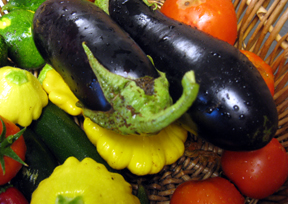
 One of the early eggplant harvests

We did a major harvest in early September and got about 15 lbs of eggplant.  I processed most of it into breaded, pan-fried cutlets for the freezer but also made a few mixed vegetable sides and a Spicy Szechuan Eggplant in Garlic Sauce dinner or two and some Ratatouille.

Part of the September harvest

Eggplant Cutlets

Our "first frost date" is officially October 1 so starting before the end September we keep an eagle eye on the weather forecasts and try and be ready to do a big, last minute, final harvest from the veggie garden when it's time. This year we cruised through most of October with unseasonably mild nights but last week a blast of cold, windy northern air suddenly came heading our way and we had to really scramble to pick everything left before it hit.  In addition to nearly 2 bushels of sweet peppers, 1/2 bushel of jalapenos, and a few tomatoes, we wrangled another almost 20 lbs of eggplants out of the garden that night.

Right now, they are sitting in one of our commercial reach-in fridges in the dairy awaiting a) time to work with them and b) inspiration.  I know I want to make a big Moussaka, a large batch of Lamb and Eggplant with Red Chiles, and maybe a few more bags of cutlets for the freezer but I figure that is only going to use about half of it!  This is WAY too much eggplant for two people to eat in a year, I think, but after all the time and effort in growing them, and finally being successful, I refuse  to waste even a single eggplant.  It's time to hit the search engines for more ideas.

Rich Biscuit Recipe

Rich Biscuits

Ingredients
4 cp      Flour
2 TBSP    Baking Powder
1 Tsp.    Salt
1 TBSP    Sugar
2/3 Cp.   Butter
1 Cp.     Milk
1 Each    Egg
Method
1. Whisk together the dry ingredients.
2. Cut in the butter
3. Combine the egg and milk and mix just to incorporate.
4. Press or roll out and cut as desired.
5. Bake on ungreased pans @ 425°F for 10-12 minutes.

Yield: 8 Big Biscuits

Spiced Grape Recipe

Grandma's Spiced Grape Preserves

Yield:  6 Pints

Ingredients
6 lb      Concord Grapes
¼ cp      Grated Orange Zest
1 Qt      Water
4 ½ lb    Sugar
1 tsp     Ground Cinnamon
½ tsp     Ground Clove
½ tsp     Ground Allspice
½ tsp     Ground Nutmeg
Method
1.      Wash grapes well.
2.      Remove the skins and reserve them
3.      Cook pulp in until soft
4.      Sieve the pulp to remove the seeds.
5.      Add the orange peel and water; cook for 10 minutes.
6.      Add the skins back and bring to a boil.
7.      Add sugar and spices; cook over medium low heat until thick.
8.      Pour into hot sterilized jars and seal

Concord Grape Cobbler Recipe

Grandma’s Concord Grape Cobbler


Ingredients
10 Cp         Concord Grapes
2 Cp          Sugar
2 1/2 Tbsp    Tapioca
1/4 Tsp       Salt
2 Tbsp        Lemon Juice
1 Tbsp        Butter
Method
1. Slip the skins form the gapes. Reserve them for later use.
2. Heat the pulp to boiling and rub through sieve to remove seeds.
3. Combine all of the ingredients except the skins and cook until thick.
4. Add the skins and mix well.
5. Pour into an 8x8x2 pan and cover with a rich biscuit crust.
6. Bake @ 425*F for 10-12 minutes to cook biscuits.

Sunday, October 31, 2010

Remembering Concord Grapes


Where we live in northern Arizona, because of our high elevation (about 6000' above sea level) we get four true seasons.  Yes that includes winter with hard freezes and sometimes snow storms that leave us with a couple feet of the white stuff to deal with.

We had our first killing frost of the season last week (running a bit late this year, it was) and while we got most of the produce out of the gardens in time I couldn't help remembering back to my family's home in CT where the first frost of the season meant we could FINALLY harvest one of my favorite things from the gardens there...
Concord Grapes!
"The sun, with all those planets revolving around it and dependent on it, can still ripen a bunch of grapes as if it had nothing else in the universe to do."

Galileo Galilei

Planted along the base of the white board fencing that bordered one side of the produce gardening plots at our family's home in Cornwall Connecticut were eight Concord grape vines.  I’m not sure when my father planted them but I remember being told that they had been grown from cuttings from the vines that my grandparents had been growing long before I was born.  I do know that by the time I was getting involved in the garden that they already looked gnarled and ancient to me with their bottom trunks as big around as my arms.

We never really did very much viticultural work on the vines.  I understand that professional grape growers and vintners have quite an annual pruning and training regime to which they adhere to get their vines to produce the best grapes in the proper abundance for flavor, acidity and sugar balances.  Our regime was to, basically, ignore the vines completely until such a point we noticed that they were impossible to harvest from because of the tangle of plant matter, or until they were reaching out to take over another section of the garden, strangle a nearby tree or smother the house.  When that occurred we would brutally chop out most of the growth and allow it to come back the next year from stubs.
I know that the regular annual transformation of the plants from their matted, barren, and sinister winter form, through spring’s budding out, summers full green leafy canopy and into autumn’s crisping leaves and eventual harvest was one of the most reliable of nature’s seasonal calendars.
Having grape arbors was pretty neat growing up, not just because the dense foliage made a great place to hide out and build “forts”, or because of the myriad of birds that would be attracted as the fruit ripened in the fall, but because it was the very last thing we harvested for the year.  Sometimes some of the grapes would ripen early but they weren't the best ones, not by a long shot.  The best grapes were the ones we picked after the first hard frost of the season, one that would really wilt the leaves.  That was when the sugars really set in the fruit and that was when we went out with our baskets and picked every bunch we could find and bring them into the warmth of the kitchen to sort through.  I remember popping the occasional super-plump and juicy fruit out of its skin, into the air to be caught in our mouths and swallowed seeds and all.  The skins would stain our hands quite purple but we didn't care.
Grape jelly, Grape Juice, Grape Cobbler and Grape Pie all took turns getting made during the Concord Grape harvest but the one thing I remember most fondly is the Spiced Grape Preserves my grandmother put up every year.  Like a jam but coarser and heavily perfumed with freshly ground clove, allspice, and mace among many others, it was closer to a chutney or other sweet condiment than it was to a breakfast spread.  I remember it being served on the side with a venison dish and how that wonderful and complex taste combination awoke my budding palate.